no scale. no stretch and folds. just bread.
there’s a version of sourdough that lives on the internet in grams and percentages — 500g flour, 350g water, 68% hydration, four sets of stretch and folds at thirty minute intervals, a timer for everything. it’s a beautiful, precise way to bake. it is not the way I was taught.
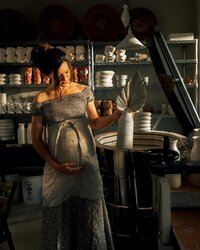
my mother taught me sourdough the way her hands knew it. no scale on the counter. no charts. just watching — the way the dough looked, the way it felt, the way it smelled when it was ready for the next thing. that’s the version I want to write down here, because I think a lot of people get talked out of baking bread before they ever start, convinced they need equipment and precision they don’t actually have room for. you don’t.
the starter
if you don’t have a starter yet, that’s its own post — but the short version is flour and water, fed daily, until it’s bubbly and smells sour-sweet, like yogurt with an edge. you’ll know it’s ready to bake with when it floats in a cup of water. that’s the only test that matters.
mixing, without measuring
pour your starter into a bowl. add flour a bit at a time, mixing with your hand, until the dough starts to come together and pull away from the sides of the bowl. it should feel tacky, not wet, not dry — like it wants to stick to your fingers but doesn’t quite. add water if it feels stiff. add flour if it feels loose. this is the whole method: adjust until it feels right, not until a number tells you it’s right.
salt goes in early, a good pinch, mixed through by hand until you can’t feel any grit.
instead of stretch and folds: just wait
stretch and folds exist to build gluten structure through repeated handling over time. but dough builds that structure on its own if you give it enough time and warmth — it just takes patience instead of technique. so instead of coming back every thirty minutes, I let the dough sit, covered, somewhere warm, and mostly leave it alone.
every few hours, if I think of it, I’ll reach in and give the dough one fold — pull a corner up and over itself, turn the bowl, do it again a few times. not on a schedule. just when I pass by and remember. the dough doesn’t need me hovering over it. it needs time.
how to know it’s ready
this is the part my mother was best at teaching, because it isn’t written anywhere — it’s watched. the dough is ready to shape when it’s visibly puffed, jiggly when you nudge the bowl, and holds an indent from your finger that slowly springs halfway back. press it and if it springs back immediately, it needs more time. if it doesn’t spring back at all, it’s gone too far — still bakeable, but it won’t rise as much in the oven.
shaping and baking
turn the dough out onto a floured counter. fold it gently into itself a few times to build a little tension on the surface, then flip it seam-side down and let it rest, covered, for twenty minutes or so before shaping it properly into a round. into the fridge overnight, or onto the counter for another hour or two if you want to bake same-day.
bake it hot and covered — a dutch oven works, lid on, oven as hot as it will go — for about thirty minutes, then uncovered another fifteen to twenty until the crust is deep and the bottom sounds hollow when you knock on it.
why this way
I don’t think precision is wrong. some people love the rhythm of it, the numbers, the control. but I think there’s another way in, one that asks you to pay attention instead of measure — to notice how dough feels today versus yesterday, how a warm kitchen changes the timeline, how your own hands start to know before your mind does. that’s what my mother handed me, more than a recipe. a way of watching.
the bread that comes out of this method isn’t identical loaf to loaf. some rise higher, some are denser, some have a more open crumb. I’ve made peace with that. it tastes like bread made by hand, because it is.
if you’ve been putting off sourdough because it felt too technical — start here. you already have everything you need to feel your way through it.
How it started >
I make pottery to elevate the daily rituals; the first cup of coffee, gathering around a table, second cup of coffee, and shepherding children.
welcome