A guide to intentional living
Buy Less.
Choose Better.
Live Beautifully.
On the quiet art of owning only what you love
We live in an age of abundant everything — and yet so many of us feel surrounded by clutter, drained by choices, and somehow still unsatisfied. What if the secret to a more beautiful life wasn’t more, but far, far less?
The Illusion of More
Modern consumer culture has sold us a compelling story: that happiness lies just one purchase away. A better blender, a newer coat, the right sofa. We buy in moments of boredom, anxiety, or aspiration — and for a brief moment, it works. The dopamine hits. Then the item arrives, gets absorbed into the background of our lives, and the craving returns.
This isn’t a character flaw. It’s the result of billions of dollars spent engineering desire. But once you name it, you begin to see through it. And once you see through it, you can choose differently.
“The things you own end up owning you. It’s only after you lose everything that you’re free to do anything.”
— Fight Club
Research consistently shows that beyond a certain threshold, more possessions don’t increase wellbeing — they diminish it. More to maintain, more to organize, more visual noise pulling at your attention. Simplicity, it turns out, is a form of luxury.
What “Choosing Better” Actually Means
Buying less doesn’t mean buying cheap. It doesn’t mean deprivation, bare walls, or a wardrobe of three identical grey t-shirts (unless that genuinely delights you). It means shifting the question from how much can I afford? to what is truly worth having?
It means slowing down enough to notice the difference between want and longing — between impulse and intention. It means choosing things made with care, designed to last, and aligned with the life you actually live rather than the life you imagine having.
-
Buy for your real life, not your ideal life The beautiful copper pan is pointless if you only cook on Sundays. Choose what serves who you are, not who you imagine you might become.
-
Favor longevity over novelty A well-made object that lasts a decade costs less — financially and environmentally — than five mediocre ones. Quality compounds over time.
-
Let beauty be a criterion You interact with your possessions every day. It is not frivolous to want them to be beautiful. Ugliness is a slow drain on your energy.
-
Value craftsmanship and provenance Knowing who made something, and how, deepens your appreciation and connection to it. Things with stories become heirlooms.
-
One in, one out Before anything new enters your home, something must leave. This single discipline transforms consumption from mindless to mindful.
The Waiting Room Method
The most powerful tool against impulse buying is also the simplest: time. Before purchasing anything non-essential, put it in a list — a wishlist, a note, a saved cart. Then wait. One week for everyday items. One month for significant purchases.
Most of the time, when you return to the list, the desire has dissolved. The want was situational — tied to a mood, a moment, a feeling you were trying to fix. This isn’t about willpower. It’s about inserting a gap between feeling and action, and letting clarity do its quiet work.
When you do return to the item and still want it just as much, you’ll buy it with full confidence — and that certainty transforms ownership into something richer. It’s yours, truly and deliberately chosen.
Creating Space for Beauty to Breathe
One of the most underrated benefits of owning less is what it does to your space. When a room isn’t fighting for attention with clutter, the things you do love become visible. A single ceramic vase. A shelf of books you’ve actually read. Morning light on an uncluttered table.
Emptiness, in good design, is not nothing — it is the thing that lets everything else speak. The Japanese concept of ma (間) — the meaningful pause, the purposeful void — captures this beautifully. Space between objects is not wasted space. It is what allows each object to exist fully.
Perfection is achieved not when there is nothing more to add, but when there is nothing left to take away.
— Antoine de Saint-Exupéry
When you clear the surface, you begin to see the surface itself — its grain, its color, the way light crosses it at four in the afternoon. This is the reward for restraint: you start noticing the world again.
Before You Buy: A Checklist
Carry these questions with you. They take thirty seconds and will save you years of regret, clutter, and money.
The Considered Purchase Checklist
- Do I need this, or do I simply want it right now in this moment?
- Do I already own something that serves this purpose?
- Where will this live in my home — specifically?
- Will I still want this in six months?
- Is this the best version of this thing I can afford, or am I settling?
- Who made this, and how? Does that matter to me?
- Would I still want this if it weren’t on sale?
- Am I buying this to solve a feeling? If so, what feeling — and is this the real remedy?
- If I owned this for ten years, would that feel right?
- What would I have to let go of to make room for this?
Living Beautifully Is a Practice
None of this is about achieving some final, perfect state. It’s a practice — a way of paying attention that you return to, again and again. You will still buy things you later regret. You will still feel the pull of a sale, the appeal of novelty, the seductive promise of a new beginning hiding inside a cardboard box.
But gradually, something shifts. You begin to trust your taste. You stop consuming to fill time or ease discomfort. You start thinking in terms of decades rather than seasons. You accumulate fewer things — and feel, paradoxically, richer.
Because a life built around a handful of deeply loved, carefully chosen things is a life where your values and your surroundings are finally in agreement. And that alignment — that quiet coherence — is what living beautifully actually feels like.
Not more, but better. Not full, but chosen. Not perfect, but yours — entirely, deliberately, beautifully yours.
How it started >
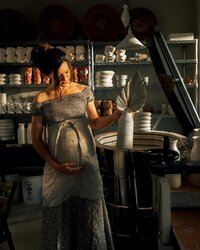
I make pottery to elevate the daily rituals; the first cup of coffee, gathering around a table, second cup of coffee, and shepherding children.
welcome